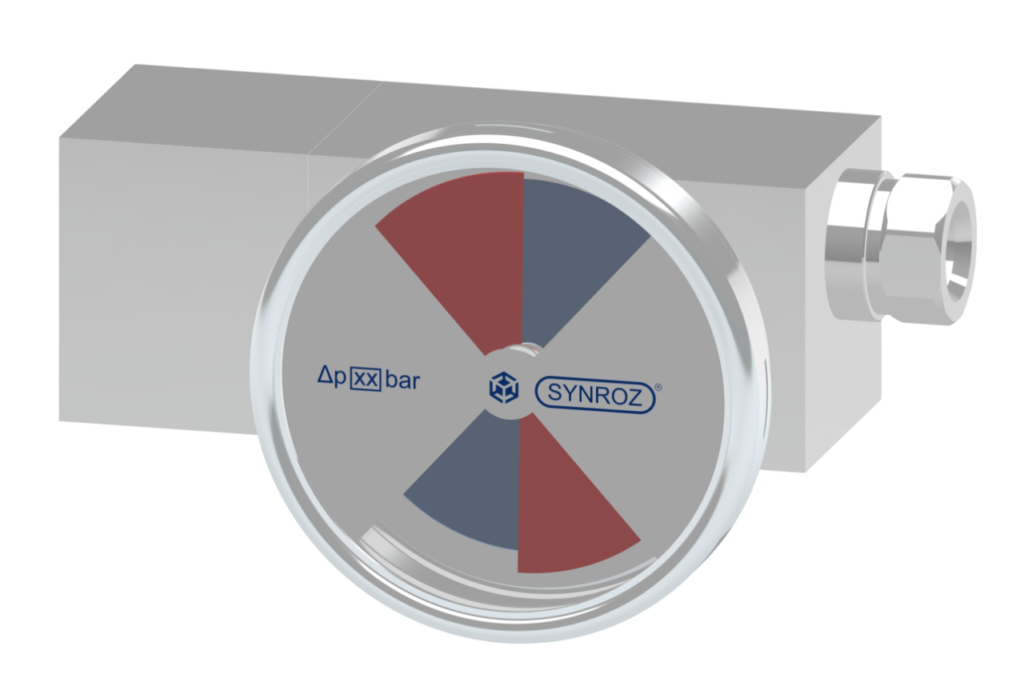
This instrument employs a flexible diaphragm as its main sensing element that separates the high and low pressure sides of the filter. The differential pressure across the diaphragm increases as the filter clogs. As the pressure rises, the diaphragm flexes, moving an internal magnet mechanically connected to it. This motion is transmitted magnetically—without any direct fluid path—through a solid barrier to an external rotary magnet or ferrous ring present on indication ring. that serves as the visible indicator on the device dial.
When the pressure difference reaches the preset threshold, the magnetic coupling either rotates a pointer or triggers a spring-loaded button to pop up in the case of mechanical “pop-up” indicators.
Manufacturers integrate this principle in devices for hydraulic oil, air, or water systems, often featuring mechanical pop-up indicators or dial pointers. The diaphragm type is most common for general-purpose filter and pump monitoring, offering reliable performance even in high static pressure environments.
This approach ensures operational safety, efficiency, and extended system lifetime through proactive clogging alerts.
Applications and Advantages
- Used in hydraulic systems, air and water filtration, and industrial process control.
- Provides a clear visual or electrical signal when a filter is clogged, ensuring timely maintenance and preventing system damage.
- The magnetic coupling ensures total isolation between the moving indicator and process media, preventing leaks and reducing wear for increased durability.
- Can operate in harsh industrial environments due to robust diaphragm and sealed construction.